

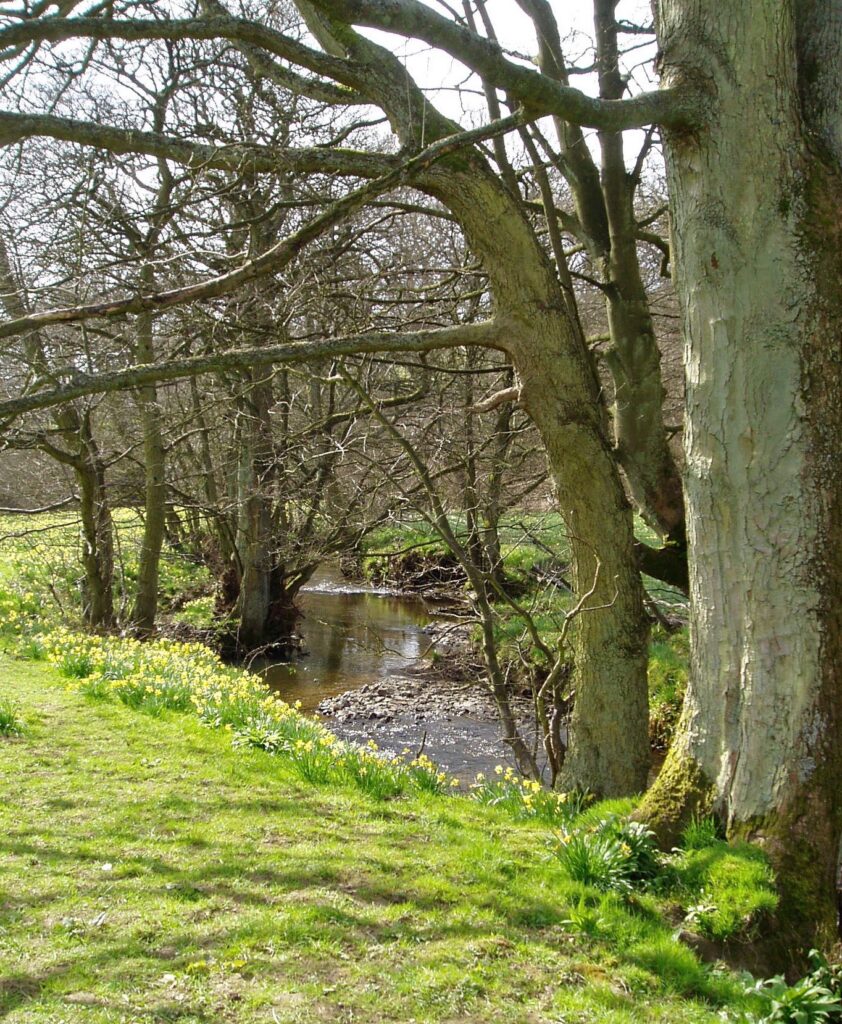
Ins Grüne, ins Grüne,
Da lockt uns der Frühling, der liebliche Knabe,
Und führt uns am blumenumwundenen Stabe
Hinaus, wo die Lerchen und Amseln so wach,
In Wälder, auf Felder, auf Hügel, zum Bach,
Ins Grüne, ins Grüne.

Into the countryside, into the countryside!
Spring, that lovely lad, is luring us there
And leading us with a staff that has flowers twisted around it,
Outside, where the larks and blackbirds are so awake,
Into the woods, onto the fields, onto the hills, to the river,
Into the countryside, into the countryside.

Reil, Das Lied im Grünen	D 917
Dornbach is the name of a small village and a brook (Bach) in the Vienna Woods (the Wienerwald), and this is where Reil and his friends were bound as they sang these verses. The brook is central to their idea of the countryside as an idyllic escape. Although the city has a major river (the Danube), its inhabitants feel the need to stroll by a smaller stream.
The Bach (cognate with the word ‘beck’, which is still used to refer to small unnavigable rivers in the north of England) is central to pastoral poetry in German. When Moses Mendelssohn produced a German version of Psalm 23 (a quintessential pastoral text) he translated ‘he leadeth me beside the still waters’ as ‘Er leitet mich an stillen Bächen’.
Gott ist mein Hirt, mir wird nichts mangeln,
Er lagert mich auf grüne Weide,
Er leitet mich an stillen Bächen.

The Lord is my shepherd; I shall not want.
He maketh me to lie down in green pastures:
he leadeth me beside the still waters.

Moses Mendelssohn, Der 23. Psalm 	D 706
When Gottfried August Bürger hymned the attractions of his rural retreat, it was a small stream that was central to the idyll:
Dort kränzen Schlehen
Die braune Kluft,
Und Pappeln wehen
In blauer Luft.
Mit sanftem Rieseln
Schleicht hier gemach
Auf Silberkieseln
Ein heller Bach,
Fließt unter den Zweigen,
Die über ihn
Sich wölbend neigen,
Bald schüchtern hin.
Lässt bald im Spiegel
Den grünen Hügel,
Wo Lämmer gehn,
Des Ufers Büschchen
Und alle Fischchen
Im Grunde sehn.

Over there sloe bushes garland
The brown cleft,
And poplar trees sway
In the blue air.
With a gentle burbling
And without hurrying, sneaking along
Over the silver pebbles
Is a clear brook;
It flows under the branches
Which cover it
As they bend over and look down,
Suddenly bashful;
Then it serves as a mirror
For the green hill
Where lambs gambol,
For the bushes on the bank
And all the fish
On the river bed can be seen.

Gottfried August Bürger, Das Dörfchen	D 598, D 641
These pastoral settings with their gentle streams are comfortable refuges but even in Arcadia there is loss and grief. A number of the Schubert song texts about small rivers are inevitably laments.
Die Wiese blüht, der Büsche Grün
Ertönt von Frühlingsmelodien,
Es wallt der Bach im Abendstrahl
Hinab ins hainumkränzte Tal:

Doch es erhebt der Haine Lied,
Die Au, die tausendfarbig blüht,
Der Erlenbach im Abendlicht
Wie vormals meine Seele nicht!

The meadow blossoms, the green of the bushes
Rings out with the melodies of spring,
In the evening light the brook winds
Down into the valley garlanded by woods:

But the song of the woodlands no longer touches me,
The meadow that blossoms into a thousand colours,
The stream through the alder trees in the light of evening,
These things do not raise my soul as they used to!

Matthisson, Klage	D 415

Du brachst sie nun, die kalte Rinde,
Und rieselst froh und frei dahin,
Die Lüfte wehen wieder linde,
Und Moos und Gras wird neu und grün.

Allein, mit traurigem Gemüte
Tret ich wie sonst zu deiner Flut,
Der Erde allgemeine Blüte
Kommt meinem Herzen nicht zu gut.

Hier treiben immer gleiche Winde,
Kein Hoffen kommt in meinen Sinn,
Als dass ich hier ein Blümchen finde,
Blau, wie sie der Erinnrung blühn.

You have broken it now, that cold crust,
And you are rippling onwards freely and merrily.
The breezes are blowing soothingly again,
And the moss and grass are becoming new and green.

Alone, in a sad mood,
I trudge towards your waters as before.
The general blossoming of the Earth
Is not doing my heart any good.

Here it is the same prevailing winds that continue to blow,
No hope enters my mind
Other than that I might find a small flower here:
Blue, like those that bloom in my memory.

Schober, Am Bach im Frühlinge	D 361

Meine Ruh ist dahin,
Meine Freud ist entflohn;
In dem Säuseln der Lüfte,
In dem Murmeln des Bachs
Hör ich bebend nur Klageton.

My peace is gone,
My joy has flown off,
In the murmuring of the breezes,
In the babbling of the brook,
Trembling, I only hear the sound of lament.

Rochlitz, Klaglied	D 23
In dem Murmeln des Bachs Hör ich bebend nur Klageton. In the babbling of the brook, Trembling, I only hear the sound of lament. Human beings hear their own concerns in the sounds of streams. Babbling brooks accompany our laments, but also other emotions. For people in love the stream might sigh with the beloved’s name:
Leise rieselnder Quell! ihr wallenden, flispernden Pappeln;
Euer Schlummergeräusch wecket die Liebe nur auf.
Linderung sucht' ich bei euch, und sie zu vergessen, die Spröde,
Ach und Blätter und Bach seufzen, Luise! dir nach.

Gentle, trickling spring! You swaying, whispering poplars;
Your sleepy sounds only serve to awaken love.
I came to you looking for comfort and to forget her - the one who is hard to get.
Alas, both the leaves and the brook are sighing for you, Luise!

Salis-Seewis, Der Jüngling an der Quelle	D 300
Yet for those in agony, on the verge of the abyss, the sound of a similar small stream can evoke a howl of pain:
Horch - wie Murmeln des empörten Meeres,
Wie durch hohler Felsen Becken weint ein Bach,
Stöhnt dort dumpfig tief ein schweres, leeres
Qualerpresstes Ach!

Listen! Like the murmuring of the rebellious sea,
Like a brook crying its way through a hole in hollow rock,
Deep down there in the damp you can hear the groaning of a heavy, empty
Agonised Ahh!

Schiller, Gruppe aus dem Tartarus	D 396, D 583
When brooks babble and streams sigh in pastoral poetry there is an inevitable sense of motion and change. The river is not a static image. Its flow evokes the passage of time and the inexorability of death. In Der Jüngling am Bache Schiller gives voice to a young lad sitting by the source of a river (eine Quelle) which soon turns into a flowing stream. It is not just flowing past him, it is flowing away, as is his own youth and the hope that is supposed to accompany it.
An der Quelle saß der Knabe,
Blumen wand er sich zum Kranz,
Und er sah sie fortgerissen,
Treiben in der Wellen Tanz.
Und so fliehen meine Tage
Wie die Quelle rastlos hin,
Und so bleichet meine Jugend,
Wie die Kränze schnell verblühn.

Fraget nicht, warum ich traure
In des Lebens Blütenzeit!
Alles freuet sich und hoffet,
Wenn der Frühling sich erneut.
Aber diese tausend Stimmen
Der erwachenden Natur
Wecken in dem tiefen Busen
Mir den schweren Kummer nur.

A lad sat by the spring
Binding flowers into a wreath,
And he watched them being pulled away
Swirling in the dance of the waves.
"And that is how my days fly off
Without a rest, like this spring!
That is how my youth fades,
Just as quickly as blossoms on wreaths.

Do not ask why I am mourning
In the blossom time of life.
Everything enjoys itself and is hopeful
When spring renews itself.
But these thousand voices
Of awakening nature
Wake in the depths of my breast
Nothing but great misery.

Schiller, Der Jüngling am Bache	D 30, D 192, D 638
If a babbling brook and a flowing stream symbolise the passage of time and the course of human life what is the significance of a frozen and silent beck? This is one of the questions posed by Müller in Winterreise.
Der du so lustig rauschtest,
Du heller, wilder Fluss,
Wie still bist du geworden,
Giebst keinen Scheidegruß!

Mit harter, starrer Rinde
Hast du dich überdeckt,
Liegst kalt und unbeweglich
Im Sande ausgestreckt.

In deine Decke grab ich
Mit einem spitzen Stein
Den Namen meiner Liebsten
Und Stund und Tag hinein:

Den Tag des ersten Grußes,
Den Tag, an dem ich ging;
Um Nam und Zahlen windet
Sich ein zerbrochner Ring.

Mein Herz, in diesem Bache
Erkennst du nun dein Bild? -
Ob's unter seiner Rinde
Wohl auch so reißend schwillt?

You who used to babble with such pleasure,
You bright, savage river,
How quiet you have become,
You have not even said 'goodbye'.

With a solid, stiff crust
You have covered yourself,
You are lying cold and motionless
Stretched out in the sand.

On your surface I shall carve,
Using a sharp stone,
The name of my beloved
Along with the the date and time:

The day of our first greeting,
The day when I left,
Wound around the name and figures
Is a broken ring.

My heart, in this stream
Do you recognise an image of yourself?
Under its crust is there
A similar tumultuous swelling?

Müller, Auf dem Flusse	D 911/7
☙
Descendant of:
WaterTexts with this theme:
- Klaglied, D 23 (Friedrich Rochlitz)
- Der Jüngling am Bache, D 30, D 192, D 638 (Friedrich von Schiller)
- Elysium, D 51, D 53, D 54, D 57, D 58, D 60, D 584 (Friedrich von Schiller)
- Der Abend, D 108 (Friedrich von Matthisson)
- Lied der Liebe, D 109 (Friedrich von Matthisson)
- Sehnsucht (Was zieht mir das Herz so?), D 123 (Johann Wolfgang von Goethe)
- Lied im Freien, D 133, D 572, D Anh. I, 19 (Johann Gaudenz von Salis-Seewis)
- An den Mond (Geuß, lieber Mond), D 193 (Ludwig Christoph Heinrich Hölty)
- Auf den Tod einer Nachtigall, D 201, D 399 (Ludwig Christoph Heinrich Hölty and Johann Heinrich Voß)
- Das Finden, D 219 (Ludwig Theobul Kosegarten)
- Die Täuschung, D 230 (Ludwig Theobul Kosegarten)
- Willkommen, lieber schöner Mai, D 244 (Ludwig Christoph Heinrich Hölty and Johann Heinrich Voß)
- Die Fröhlichkeit, D 262 (Martin Joseph Prandstetter)
- Liane, D 298 (Johann Baptist Mayrhofer)
- Der Jüngling an der Quelle, D 300 (Johann Gaudenz von Salis-Seewis)
- Schwangesang, D 318 (Ludwig Theobul Kosegarten)
- Fischerlied, D 351, D 364, D 562 (Johann Gaudenz von Salis-Seewis)
- Am Bach im Frühlinge, D 361 (Franz Adolph Friedrich von Schober)
- Laura am Klavier, D 388 (Friedrich von Schiller)
- Gruppe aus dem Tartarus, D 65, D 396, D 583 (Friedrich von Schiller)
- Daphne am Bach, D 411 (Friedrich Leopold Graf zu Stolberg-Stolberg)
- Klage (Die Sonne steigt, die Sonne sinkt), D 415 (Friedrich von Matthisson)
- Trauer der Liebe, D 465 (Johann Georg Jacobi)
- Die Perle, D 466 (Johann Georg Jacobi)
- Leiden der Trennung, D 509 (Pietro Metastasio and Heinrich Joseph von Collin)
- Der Alpenjäger, D 588 (Friedrich von Schiller)
- Das Dörfchen, D 598 (Gottfried August Bürger)
- Einsamkeit, D 620 (Johann Baptist Mayrhofer)
- Widerschein, D 639, D 949 (Franz von Schlechta)
- Der 23. Psalm, D 706 (Moses Mendelssohn)
- Greisengesang, D 778 (Friedrich Rückert)
- Wohin? D 795/2 (Wilhelm Müller)
- Danksagung an den Bach, D 795/4 (Wilhelm Müller)
- Des Müllers Blumen, D 795/9 (Wilhelm Müller)
- Tränenregen, D 795/10 (Wilhelm Müller)
- Der Jäger, D 795/14 (Wilhelm Müller)
- Der Müller und der Bach, D 795/19 (Wilhelm Müller)
- Des Baches Wiegenlied, D 795/20 (Wilhelm Müller)
- Coronach (Totengesang der Frauen und Mädchen), D 836 (Walter Scott and Philip Adam Storck)
- Im Freien, D 880 (Johann Gabriel Seidl)
- Fischerweise, D 881 (Franz von Schlechta)
- Auf dem Flusse, D 911/7 (Wilhelm Müller)
- Das Lied im Grünen, D 917 (Friedrich Reil)
- Der Triumph der Liebe, D 55, D 61, D 62, D 63, D 64, D 983A (Friedrich von Schiller)
- Der Graf von Habsburg, D 990 (Friedrich von Schiller)