


It perhaps takes a poet to realise how deceptive some everyday words can be. Goethe, being not only a great poet but also a serious naturalist, noticed that not all the water in a waterfall falls. Visiting the Staubach Falls in Switzerland in his capacity as tutor to the Duke of Saxe-Weimar on 9th October 1779, he pointed out that water in a state of turbulence behaves in strange ways. Gusts of wind contend with of gravity. Forces compete and collide. Water, like the human soul itself, is subject to varying and variable conditions.
Des Menschen Seele
Gleicht dem Wasser.
Vom Himmel kommt es,
Zum Himmel steigt es,
Und wieder nieder
Zur Erde muss es,
Ewig wechselnd.

Strömt von der hohen
Steilen Felswand
Der reine Strahl,
Dann stäubt er lieblich
In Wolkenwellen
Zum glatten Fels,
Und leicht empfangen,
Wallt er verschleiernd,
Leisrauschend
Zur Tiefe nieder.

Ragen Klippen
Dem Sturz entgegen,
Schäumt er unmutig
Stufenweise
Zum Abgrund.

Im flachen Beete
Schleicht er das Wiesental hin,
Und in dem glatten See
Weiden ihr Antlitz
Alle Gestirne.

Wind ist der Welle
Lieblicher Buhler,
Wind mischt vom Grund aus
Schäumende Wogen.

Seele des Menschen,
Wie gleichst du dem Wasser,
Schicksal des Menschen,
Wie gleichst du dem Wind!

The human soul
Is similar to water:
It comes from the heavens,
It rises to the heavens
And back down
To earth it has to come,
Eternally changing.

Streaming from the high
Steep wall of the cliff
Is a pure beam,
Then it lovingly sprays out
In clouds of waves
Onto the smooth rocks,
And it is no sooner welcomed than
It surges and veils itself,
Rumbling gently,
And descends to the depths.

When rocks loom up
It plunges against them,
It angrily foams
Step by step
To the abyss.

In its flat bed
It slithers through the valley of meadows,
And in the smooth lake,
Feasting their eyes on their reflection,
Are all the constellations.

Wind is the waves'
Beloved partner;
The wind goes down and gets mixed with
The foaming waves.

Human soul,
How similar you are to the water!
Human fate,
How similar you are to the wind!

Goethe, Gesang der Geister über den Wassern		D 484  D 538  D 705  D 714
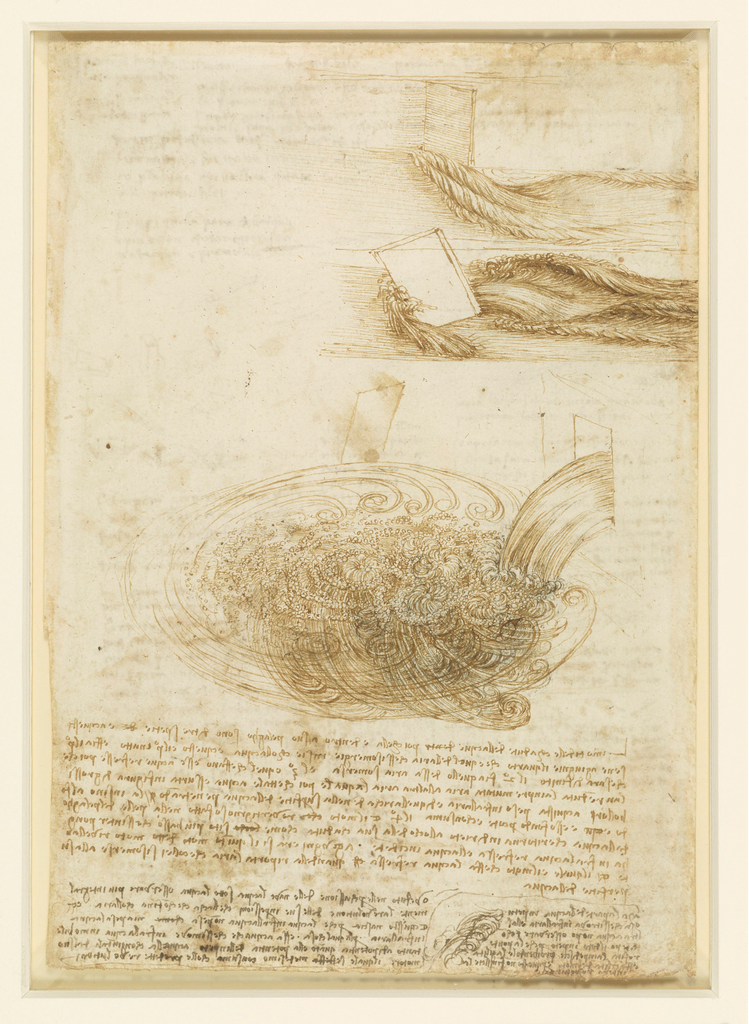
Leonardo da Vinci, movement of water, 1507-9. Windsor, Royal Library, 12660v.
In another part of the Alps a generation later another poet, Johann Mayrhofer, wrote a text originally called ‘Im Hochgebirge’ (In the high mountains). Here the waterfall is an image of sublime certainty and continuity – a contrast to the turbulence and risk that humans normally have to live with. We have to strive to recognise and cling on to what is fixed and eternal (‘Being’) amidst all of the change and decay that makes up our experience. Only then will we find the right word.
Fels auf Felsen hingewälzet,
Fester Grund und treuer Halt:
Wasserfälle, Windesschauer,
Unbegriffene Gewalt.
Einsam auf Gebirges Zinne,
Kloster- wie auch Burgruine,
Grab sie der Erinnrung ein;
Denn der Dichter lebt vom Sein.
Atme du den heil'gen Äther,
Schling die Arme um die Welt,
Nur dem Würdigen, dem Großen,
Bleibe mutig zugesellt.
Lass die Leidenschaften sausen
Im metallenen Akkord,
Wenn die starken Stürme brausen,
Findest du das rechte Wort.

Cliff piled upon cliffs,
Solid ground and trustworthy support;
Waterfalls, gusts of wind,
Unimaginable strength -
Solitary on the mountain peaks
Are the ruins of a monastery or perhaps a castle:
Etch them into your memory!
For the poet lives on existence.
Breathe in the sacred ether,
Throw your arms around the world;
Only those who are worthy, those who are great,
Courageously keep only those as your companions.
Let ardour roar
In metallic harmony;
When the strong storms rage,
You will find the correct word.

Mayrhofer, Heliopolis II	D 754
☙
Descendant of:
WaterTexts with this theme:
- Lebenstraum, D 1A, D 39 (Gabriele von Baumberg)
- Die Schatten, D 50 (Friedrich von Matthisson)
- Sehnsucht (Ach, aus dieses Tales Gründen), D 52, D 636 (Friedrich von Schiller)
- Der Taucher, D 77, D 111 (Friedrich von Schiller)
- Geisternähe, D 100 (Friedrich von Matthisson)
- Ammenlied, D 122 (Michael Lubi)
- Mignon (Kennst du das Land?), D 321 (Johann Wolfgang von Goethe)
- Laura am Klavier, D 388 (Friedrich von Schiller)
- Fragment aus dem Aeschylus, D 450 (Aeschylus and August Lafontaine)
- Gesang der Geister über den Wassern, D 484, D 538, D 705, D 714 (Johann Wolfgang von Goethe)
- Der Schiffer, D 536 (Johann Baptist Mayrhofer)
- Einsamkeit, D 620 (Johann Baptist Mayrhofer)
- Heliopolis II, D 754 (Johann Baptist Mayrhofer)
- Wehmut (Die Abendglocke tönet), D 825 (Heinrich Hüttenbrenner)
- Der liebliche Stern, D 861 (Ernst Konrad Friedrich Schulze)
- Wasserflut, D 911/6 (Wilhelm Müller)