

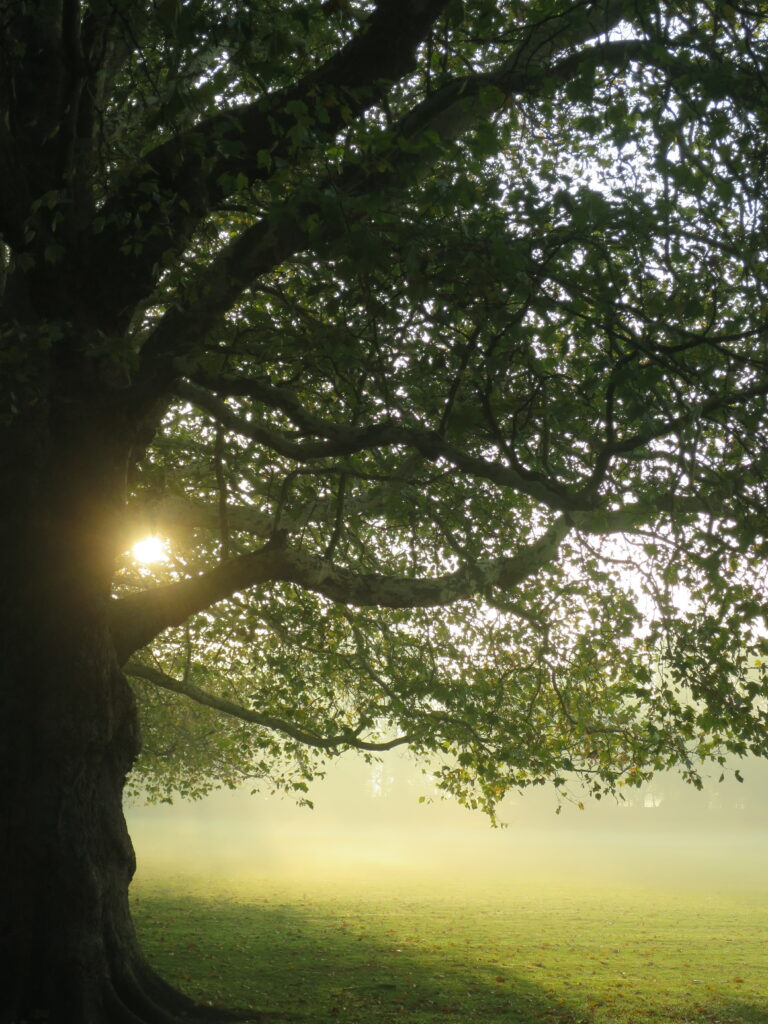
Wenn über Berge sich der Nebel breitet,
Und Luna mit Gewölken kämpft,
So nimmt der Alte seine Harfe und schreitet
Und singt waldeinwärts und gedämpft:
      Du heil'ge Nacht,
      Bald ist's vollbracht,
      Bald schlaf ich ihn,
      Den langen Schlummer,
      Der mich erlöst
      Von allem Kummer.
   Die grünen Bäume rauschen dann:
   Schlaf süß, du guter alter Mann;
   Die Gräser lispeln wankend fort:
   Wir decken seinen Ruheort;
   Und mancher liebe Vogel ruft:
   O lasst ihn ruhn in Rasengruft.

Der Alte horcht, der Alte schweigt,
Der Tod hat sich zu ihm geneigt.


When the mist spreads across the mountains
And Luna goes into battle against the clouds,
That is when the old man takes his harp and steps forwards,
And turning towards the forest sings in muffled tones:
       "Oh holy night!
       It will soon be fulfilled.
       I shall soon be sleeping
       That long sleep
       Which will release
       Me from all care."
   The green trees then rustle,
   'Sleep sweetly, good old man';
   The blades of grass whisper as they sway,
   'We shall cover his place of rest';
   And many a dear bird cries out,
   'Oh let him rest in this trench in the turf!' -

The old man pays attention, the old man remains silent -
Death has bent down towards him.

Mayrhofer, Nachtstück	D 672
As the mist spreads across the mountains the scene is set. The lighting is suitably atmospheric as clouds win their battle against the moonlight. Into the spotlight steps a musician who is about to take his final bow. This is his last appearance on this or any stage.
In an age before electric lighting and dry ice were used to create a sense of ominous anticipation in the theatre, poets had no difficulty using mist and fog for scene setting such as this. Schiller used the same effect to set the scene for a funeral:
Mit erstorbnem Scheinen
Steht der Mond auf totenstillen Hainen,
Seufzend streicht der Nachtgeist durch die Luft -
Nebelwolken trauern.
Sterne trauern
Bleich herab, wie Lampen in der Gruft.
Gleich Gespenstern, stumm und hohl und hager,
Zieht in schwarzem Totenpompe dort
Ein Gewimmel nach dem Leichenlager
Unterm Schauerflor der Grabnacht fort.

With its dying light
The moon stands over the deadly quiet groves
The spirit of night sighs through the air,
Clouds of mist mourn,
Stars mourn
Sending down a pale light, like lamps in a vault.
Like ghosts, silent, hollow and thin,
There is a procession, in black funeral attire;
A group of mourners follows the coffin
Under the fearful veil of the burial night.

Schiller, Leichenfantasie 	D 7
In Bruchmann’s Schwestergruß the ghost of the poet’s sister seems to emerge from the mist in a graveyard:
Im Mondenschein
Wall ich auf und ab,
Seh Todtenbein'
Und stilles Grab.

In Geisterhauch
Vorüber schwebt's,
Wie Flamm und Rauch,
Vorüber bebt's; -

Aus Nebeltrug
Steigt eine Gestalt

In the moonlight
I process up and down,
I can see the bones of the dead
And quiet graves.

With the breath of a spirit
Something passes by me,
Like flame and smoke,
Something trembles ahead of me;

Appearing to emerge from the mist
A form climbs out

Bruchmann, Schwestergruß	D 762
However, mist and fog are not necessarily ominous. As well as creating an atmosphere of foreboding and evoking the uncanny, they also appear in narrative poetry to signify a movement away from confusion or uncertainty and towards clarity. Mist sometimes clears or the fog rises.
Ach, aus dieses Tales Gründen,
     Die der kalte Nebel drückt,
Könnt ich doch den Ausgang finden,
     Ach, wie fühlt' ich mich beglückt.
Dort erblick ich schöne Hügel,
     Ewig jung und ewig grün,
Hätt' ich Schwingen, hätt ich Flügel,
     Nach den Hügeln zög ich hin.

Harmonien hör ich klingen,
     Töne süßer Himmelsruh,
Und die leichten Winde bringen
     Mir der Düfte Balsam zu.
Goldne Früchte seh ich glühen,
     Winkend zwischen dunkelm Laub,
Und die Blumen, die dort blühen,
     Werden keines Winters Raub.

Ach wie schön muss sich's ergehen
     Dort im ew'gen Sonnenschein,
Und die Luft auf jenen Höhen,
     O wie labend muss sie sein.
Doch mir wehrt des Stromes Toben,
     Der ergrimmt dazwischen braust,
Seine Wellen sind gehoben,
     Dass die Seele mir ergraust.

Einen Nachen seh ich schwanken,
     Aber ach! der Fährmann fehlt.
Frisch hinein und ohne Wanken,
     Seine Segel sind beseelt.
Du musst glauben, du musst wagen,
     Denn die Götter leihn kein Pfand,
Nur ein Wunder kann dich tragen
     In das schöne Wunderland.

Oh, to get out of the bottom of this valley
Filled with cold mist;
If only I could find the way out
How happy I would feel!
I can make out beautiful hills over there,
Forever young and forever green.
If only I had wings; if only I could fly,
I would set off for those hills.

I can hear harmonies resounding,
The notes of sweet heavenly rest,
And the light winds are bringing
Me the fragrance of balsam.
I can see golden fruit glowing,
Waving within the dark foliage,
And the flowers that bloom there
Will never be ravaged by winter.

Oh how lovely it must be to stroll
There in the eternal sunshine;
And the air on those heights,
How refreshing it must be!
But I am hindered by the raging stream
That angrily roars and blocks my way.
Its waves are raised so high
That my soul is horrified.

I can see a boat rocking.
But oh! There is no ferry man.
Get in quick, don’t delay.
Its sails are hoisted.
You have to believe, you have to dare,
For the gods do not offer any security.
Only a miracle can convey you
To that beautiful land of wonders.

Schiller, Sehnsucht	D 52, D 636
This emerging clarity is often related to the metaphor of the ‘veil of mist’. This is the final image in Müller´s Die Schöne Müllerin, as the dying protagonist’s confusion finally comes to an end:
Gute Nacht, gute Nacht,
Bis alles wacht.
Schlaf aus deine Freude, schlaf aus dein Leid.
Der Vollmond steigt,
Der Nebel weicht,
Und der Himmel da droben, wie ist er so weit.

Good night, good night!
Until everything wakes up,
Sleep off your joy, sleep off your pain!
The full moon is rising,
The mist is clearing,
And the sky up there, how expansive it is!

Müller, Des Baches Wiegenlied	D 795/20
Johannes Mayrhofer found the experience of listening to a Schubert song something akin to a veil being removed. As Schubert’s music rings out it is as if the sunlight is breaking through the mist.
Sag an, wer lehrt dich Lieder,
So schmeichelnd und so zart?
Sie rufen einen Himmel
Aus trüber Gegenwart.
Erst lag das Land, verschleiert
Im Nebel vor uns da -
Du singst, und Sonnen leuchten,
Und Frühling ist uns nah.

Tell me, who teaches you songs,
Songs that are so flattering and so tender?
They summon a heaven
Out of the overcast present.
At first the veiled land lay
There before us, covered in mist -
You sing - and suns light up,
And spring is close to us.

Mayrhofer, Geheimniß	D 491
In the course of real life we might never be sure whether or not the mist surrounding us is an omen of disaster or the prelude to enlightenment. It might just be a foggy morning. We might be over-interpreting things. There again, by definition, things in the mist are not clear, so ambiguity is part of how this symbolism works. Goethe managed to capture this brilliantly in Erlkönig, where the child and his father see things so differently.
Mein Sohn, was birgst du so bang dein Gesicht? -
Siehst, Vater, du den Erlkönig nicht?
Den Erlenkönig mit Kron' und Schweif? -
Mein Sohn, es ist ein Nebelstreif. -

"My son, why are you burying your face so anxiously?" -
"Father, can't you see the Erl King?
The Erl King with his crown and tail?"
"My son, it is a streak of mist."

Goethe, Erlkönig	D 328
Did the child ‘really’ see and hear the Erl King, or was the father right, was it just a streak of mist? Which of them saw things more clearly? Were they both deluded? How can we know?
☙
Descendant of:
WATER Inanimate natureTexts with this theme:
- Leichenfantasie, D 7 (Friedrich von Schiller)
- Der Geistertanz, D 15, D 15A, D 116, D 494 (Friedrich von Matthisson)
- Sehnsucht (Ach, aus dieses Tales Gründen), D 52, D 636 (Friedrich von Schiller)
- Geisternähe, D 100 (Friedrich von Matthisson)
- Erinnerung (Kein Rosenschimmer leuchtet), D 101 (Friedrich von Matthisson)
- Rastlose Liebe, D 138 (Johann Wolfgang von Goethe)
- Der Mondabend, D 141 (Johann Gottfried Kumpf)
- Auf einen Kirchhof, D 151 (Franz von Schlechta)
- Amphiaraos, D 166 (Theodor Körner)
- Die Sterbende, D 186 (Friedrich von Matthisson)
- Der Abend (Der Abend blüht), D 221 (Ludwig Theobul Kosegarten)
- Von Ida, D 228 (Ludwig Theobul Kosegarten)
- Die Täuschung, D 230 (Ludwig Theobul Kosegarten)
- Tischlied, D 234 (Johann Wolfgang von Goethe)
- An den Mond (Füllest wieder Busch und Tal), D 259, D 296 (Johann Wolfgang von Goethe)
- Ossians Lied nach dem Falle Nathos, D 278 (James Macpherson (Ossian) and Edmund von Harold)
- Cronnan, D 282 (James Macpherson (Ossian) and Edmund von Harold)
- Shilric und Vinvela, D 293 (James Macpherson (Ossian) and Edmund von Harold)
- Idens Schwanenlied, D 317 (Ludwig Theobul Kosegarten)
- Mignon (Kennst du das Land?), D 321 (Johann Wolfgang von Goethe)
- Erlkönig, D 328 (Johann Wolfgang von Goethe)
- Der Entfernten, D 331, D 350 (Johann Gaudenz von Salis-Seewis)
- Licht und Liebe (Nachtgesang), D 352 (Matthäus Karl von Collin)
- An Schwager Kronos, D 369 (Johann Wolfgang von Goethe)
- Kantate zu Ehren von Josef Spendou, D 472 (Johann Hoheisel)
- Der Wanderer (Ich komme vom Gebirge her), D 489 (Georg Philipp Schmidt)
- Geheimnis. An F. Schubert, D 491 (Johann Baptist Mayrhofer)
- Zum Punsche, D 492 (Johann Baptist Mayrhofer)
- Abendlied (Der Mond ist aufgegangen), D 499 (Matthias Claudius)
- Herbstlied (Bunt sind schon die Wälder), D 502 (Johann Gaudenz von Salis-Seewis)
- Der Alpenjäger, D 524 (Johann Baptist Mayrhofer)
- Memnon, D 541 (Johann Baptist Mayrhofer)
- Auf dem See, D 543 (Johann Wolfgang von Goethe)
- Ganymed, D 544 (Johann Wolfgang von Goethe)
- Sonett (Apollo, lebet noch dein hold Verlangen), D 628 (Francesco Petrarca and August Wilhelm Schlegel)
- Nachtstück, D 672 (Johann Baptist Mayrhofer)
- Prometheus, D 674 (Johann Wolfgang von Goethe)
- Morgenlied (Eh die Sonne früh aufersteht), D 685 (Friedrich Ludwig Zacharias Werner)
- Schwestergruß, D 762 (Franz von Bruchmann)
- Des Tages Weihe, D 763 (Anonymous / Unknown writer)
- Willkommen und Abschied, D 767 (Johann Wolfgang von Goethe)
- Des Baches Wiegenlied, D 795/20 (Wilhelm Müller)
- Mondenschein, D 875 (Franz Adolph Friedrich von Schober)
- Des Fischers Liebesglück, D 933 (Carl Gottfried von Leitner)
- Die Stadt, D 957/11 (Heinrich Heine)
- Am Meer, D 957/12 (Heinrich Heine)