

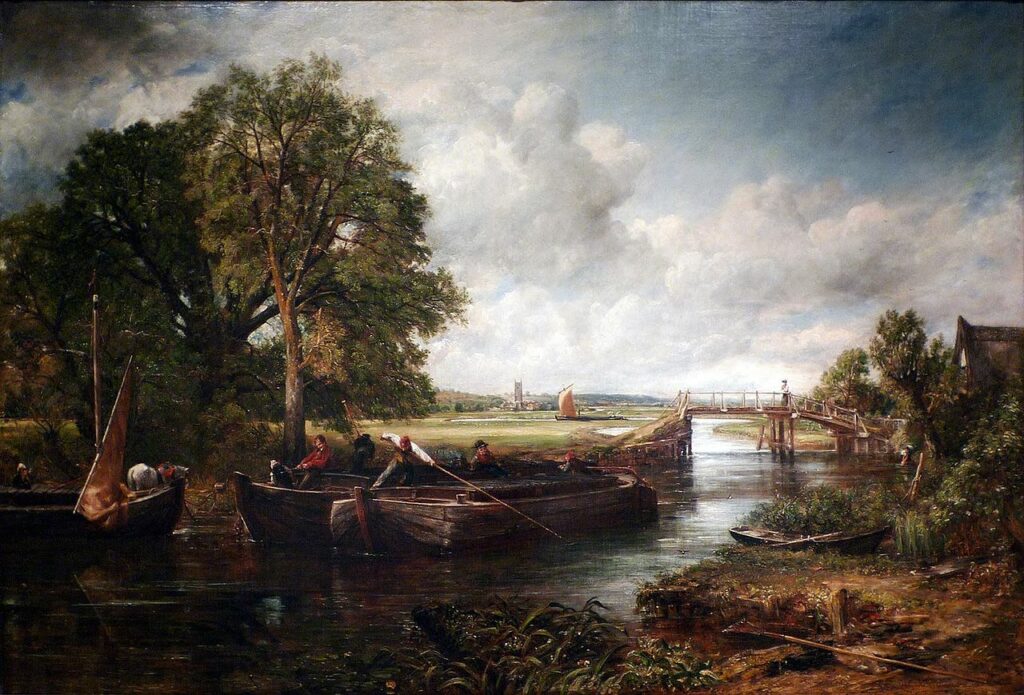
Fluß m
(a) river. am Fluß, by the river; den Fluß aufwärts / abwärts fahren, to go upstream / downstream
(b) no plural	molten mass. im Fluß sein, to be molten
(c) flow, continuity. etwas in Fluß bringen, to get something moving or going; im Fluß sein, to be in a state of flux

Flußbett nt
riverbed

Flußdiagramm nt
flowchart

Flußpferd nt
hippopotamus

flüssig adj
(a) liquid. flüssig werden, to become liquid or runny
(b) flowing, fluid. flüssig sprechen, to talk fluently
(c) available. flüssiges Vermögen, liquid assets


Modified from P. Terrell, V. Schnorr, W. V. A. Morrris, R. Breitschprecher ed., Collins German / English English / German Dictionary 2nd ed. 1991
Verfließet, vielgeliebte Lieder,
Zum Meere der Vergessenheit!
Kein Knabe sing entzückt euch wieder,
Kein Mädchen in der Blütenzeit.

Ihr sanget nur von meiner Lieben,
Nun spricht sie meiner Treue Hohn;
Ihr wart ins Wasser eingeschrieben,
So fließt denn auch mit ihm davon.

Flow on, you greatly loved songs,
Towards the sea of oblivion!
No enraptured lad is going to sing you again,
No girl at the time when flowers bloom!

You only sang about my love;
Now she speaks mockingly of my faithfulness.
You were inscribed into the water;
So you should also flow away with it.

Goethe, Am Flusse	D 160, D 766
Goethe’s fluency was remarkable. Poetry, plays, stories and scientific analysis flowed from his mouth and his pen for around 70 years. Unfortunately, though, we only encounter his works mid-stream. At a number of points in his career he burned large numbers of his writings. Thus it is that, in 1767, he said farewell to his juvenilia and shortly afterwards he wrote an envoi to his early poems in a text called ‘An meine Lieder‘ (To my songs), but with the alternative title ‘Am Flusse‘ (By the river).
Verfließet, vielgeliebte Lieder,
Zum Meere der Vergessenheit!

Flow on, you greatly loved songs,
Towards the sea of oblivion!
This river represents the poet’s astonishing identity: always changing, always open to new experience and interpretations of that experience, always unpredictable yet always himself. Rivers are like that – always there even though they are never the same. You cannot step into the same river twice. In 1767 Goethe was undergoing the first of many metamorphoses in his career as he changed approach and focus. This is what made him Goethe.
Indeed one of his enduring interests was the concept of metamorphosis itself. How could anything be itself whilst also changing? He was later to consider that his greatest contribution to knowledge was his scientific study of the Metamorphosis of Plants, his attempt to understand what continuity is involved in the transformation of acorns into oaks, of pine kernels into pine forests.
The same questions can be asked about any human life. As it flows past, into the sea of oblivion, what makes my life me? How do I retain an identity in different contexts and in relation to different people? How can my passing thoughts add up to a cumulative understanding?
Goethe returned to these questions in one of his greatest poems, An den Mond (first version 1778, revised 1789), Schubert’s D 259 and D 296. Although the text begins as an address to the moonlight that is flooding the surrounding valley, it turns into a poem about the river itself, which serves as a symbol of the course of Goethe’s own life and his relationships.
Fließe, fließe, lieber Fluß,
Nimmer werd ich froh,
So verrauschte Scherz und Kuss,
Und die Treue so.

Ich besaß es doch einmal,
Was so köstlich ist,
Dass man doch zu seiner Qual
Nimmer es vergißt.

Rausche, Fluß, das Tal entlang,
Ohne Rast und Ruh,
Rausche, flüstre meinem Sang
Melodien zu,

Wenn du in der Winternacht
Wütend überschwillst,
Oder um die Frühlingspracht
Junger Knospen quillst.

Selig, wer sich vor der Welt
Ohne Hass verschließt,
Einen Freund am Busen hält
Und mit dem genießt,

Was, von Menschen nicht gewusst,
Oder nicht bedacht,
Durch das Labyrinth der Brust
Wandelt in der Nacht.

Flow on, flow on, dear river!
I shall never be truly happy;
In such a way playfulness and kisses have faded away,
As has faithfulness.

However, I did once possess it,
That which is so valuable!
It is something so agonizing that
It can never be forgotten.

Roar away along the valley, river,
Without a break, without rest,
Roar on, accompany my song by whispering
Melodies to go with it,

When, on a winter's night,
You overflow in fury
Or, around the majesty of spring,
You swell young buds.

Blessed is anyone who, avoiding the world,
Locks themselves away without hatred
And holds a friend to their bosom
And with that person enjoys

That which, unknown to humans
Or not even imagined by them,
Through the labyrinth of the breast
Paces around during the night.

Goethe, An den Mond	D 259, D 296
Here the focus is on the continuity of the river, which is invited to sing along with the poet in all seasons and moods. Whether roaring or whispering, whether in the fury of winter or the majesty of spring, old man river just keeps rolling along ‘without a break, without rest.’ It carries away not just old songs and poems with their associated old ideas and false starts, but also serious commitments and sincere friendships which ought to have been retained and valued more fully. It confronts him with the most basic questions about who he is and how he relates to the world around him.
In many of the Schubert song texts rivers represent obstacles that get in our way. They stop us in our tracks and we are forced to reflect. In the case of Schober’s ‘Forget Me Not’ (Vergißmeinnicht, D 792), a reworking of Ovid’s story of Narcissus, the reflection is literally that.
In this strange ballad the figure of spring kisses awake a small flower before he leaves the woods. The child / flower blossoms into consciousness, but does not know who or what she is. She is aware of nothing but loss.
. . . . . . . . Tränen
Sprechen ihren Schmerz nur aus,
Und ein unergründlich Sehnen
Treibt sie aus sich selbst heraus,

Treibt sie fort, das Bild zu finden,
Das in ihrem Innern lebt,
Das ihr Ahnungen verkünden,
Das in Träumen sie umschwebt.

Felsen hat sie überklommen,
Berge steigt sie ab und auf,
Bis sie an den Fluss gekommen,
Der ihr hemmt den Strebelauf.

Doch im Ufergras, dem feuchten,
Wird ihr heißer Fuß gekühlt,
Und in seinem Spiegel leuchten
Siehet sie ihr eignes Bild,

Sieht des Himmels blaue Ferne,
Sieht der Wolken Purpurschein,
Sieht den Mond und alle Sterne,
Milder fühlt sie ihre Pein.

Denn es ist ihr aufgegangen,
Dass sie eine Seele fand,
Die ihr innigstes Verlangen,
Ihren tiefsten Schmerz verstand.

Gern mag sie an dieser Stelle
Sich die stille Wohnung baun,
Der verklärten, sanften Welle
Kann sie rückhaltslos vertraun,

Und sie fühlt sich ganz genesen,
Wenn sie zu dem Wasser spricht,
Wie zu dem geahnten Wesen:
O vergiss, vergiss mein nicht.

. . . . . . . . .  - Tears
Are all that can express her pain,
And a fathomless longing
Drives her out of herself;

It drives her off to find the image
That is living inside her,
That her intuition tells her about,
That suffuses her dreams.

She has clambered over cliffs,
She climbs up and down mountains;
Until she has come to the river,
Which puts a stop to her frenzied course.

But in the damp grass of the riverbank
Her hot foot is cooled down,
And looking into the mirror of the river
She sees her own image.

She sees the blue distance of the sky,
She sees the crimson glow of the clouds,
She sees the moon and all the stars; -
Her pain feels less acute to her.

For she has realised
That she has found a soul
That understands her innermost longings
That understands her deepest pain.

She would like to stay in this spot
And build herself a quiet home,
Where she can trust the transfigured, gentle waves,
Where she will feel complete security.

And she feels that she has been fully healed,
When she speaks to the water,
As if speaking to the being she longs for:
O forget, forget me not!


Franz von Schober, Vergißmeinnicht  D 792
When this blossoming figure comes to the river she is forced to pause and reflect. It is here that she is able to look back on what has occurred, look around and come to terms with her environment and then look forward to a future in which she can accept her loss. The flowing waters have been transfigured and her transient emotions have been transformed into a sense of security.
There is a generally accepted theory that Schober wrote Vergißmeinnicht specifically for his close friend Schubert and that he based the central figure on the composer himself. There seems to be a not very well hidden subtext which could refer to Schober’s role in Schubert attempting to come to terms and experiment with his sexuality. If that is the case, river symbolism is again crucial in exploring ideas about change and continuity in a human life. Do we lose or find ourselves when we engage in sexual activity (or are both possible)? What are the risks and benefits of going with the flow? Does our sexuality drive us in specific directions or can we channel it? Like a river, our passions will occasionally be turbulent, but we will have moments of calm too. Schober’s ballad suggests that we should attempt to understand our own life and passions in the way that this little flower manages to do when faced with the totality of her experience in the figure of the river.
Schubert’s other very close friend, Johann Mayrhofer, had already used the imagery of a river in a poem about trying to understand who we are (Geheimnis / Mystery) . Faced with the undoubted fact of Schubert’s fluency as a composer he asks where the flowing music has come from. He has to conclude, though, that the question is unanswerable. Schubert the composer does not look to the source of his creativity (‘the old man pouring out his urn’) but just at the flowing water itself. He, like us, can only be astonished.
Sag an, wer lehrt dich Lieder,
So schmeichelnd und so zart?
Sie rufen einen Himmel
Aus trüber Gegenwart.
Erst lag das Land, verschleiert
Im Nebel vor uns da -
Du singst, und Sonnen leuchten,
Und Frühling ist uns nah.

Den schilfbekränzten Alten,
Der seine Urne gießt,
Erblickst du nicht, nur Wasser,
Wie's durch die Wiesen fließt.
So geht es auch dem Sänger,
Er singt, er staunt in sich;
Was still ein Gott bereitet,
Befremdet ihn wie dich.

Tell me, who teaches you songs,
Songs that are so flattering and so tender?
They summon a heaven
Out of the overcast present.
At first the veiled land lay
There before us, covered in mist -
You sing - and suns light up,
And spring is close to us.

The old man with a garland of reeds
Who is pouring out his urn,
You do not notice him, just the water
As it flows through the meadows.
That is also how it is with the singer,
He sings, he is amazed;
What a god quietly prepares
Disconcerts him, as it does you.

Mayrhofer, Geheimniß. An F. Schubert	D 491
The flowing waters of the river and the flowing melodies of the poet’s friend Schubert simply have to be accepted as facts, however disconcerting or mysterious we find that to be. We have to remember that both poet and composer lived in Vienna, where the Danube was just such a basic given. The source was far away and inaccessible, as was the sea for which it was bound. Neither Mayrhofer nor Schubert ever saw the sea (or the source of the Danube). The river (and consequently, human life itself) could not be experienced in its totality.
Friedrich von Schlegel, though, was determined to probe this mystery and find a vantage point from which the entirety of the course of human life could be seen and understood. ‘Der Fluß‘, like Mayrhofer’s Geheimnis, begins with the conflation of music and river imagery:
Wie rein Gesang sich windet
Durch wunderbarer Saitenspiele Rauschen,
Er selbst sich wieder findet,
Wie auch die Weisen tauschen,
Dass neu entzückt die Hörer ewig lauschen.

So fließet mir gediegen
Die Silbermasse, schlangengleich gewunden,
Durch Büsche, die sich wiegen
Vom Zauber süß gebunden,
Weil sie im Spiegel neu sich selbst gefunden.

Wo Hügel sich so gerne
Und helle Wolken leise schwankend zeigen,
Wenn fern schon matte Sterne
Aus blauer Tiefe steigen,
Der Sonne trunkne Augen abwärts neigen.

So schimmern alle Wesen
Den Umriss nach im kindlichen Gemüte,
Das zur Schönheit erlesen
Durch milder Götter Güte
In dem Kristall bewahrt die flücht'ge Blüte.

In the same way that a pure song meanders
Through the miraculous resonance of strings as they are played
And finds itself again,
And just as the melodies interweave
So that the listeners, newly enraptured, continue to pay attention:

That is how, for me, the river flows so solidly
In a silver mass, twisted around like a snake,
Through bushes which sway
As they are sweetly bound up in the magic
Since they have found themselves anew in the mirror;

Where the hills are so keen
(And bright clouds are keen) to show themselves rocking gently,
While faint stars in the distance are already
Climbing out of the blue depth,
The drunken eyes of the sun bend down.

Thus it is that all beings gleam
In outline within a childlike attitude,
Which, dedicated to beauty
Through the gentle goodness of the gods,
Preserves the transitory blossom in the crystal.

Friedrich von Schlegel, Der Fluß	D 693
Just as music only makes sense with the passage of time, the flowing water of the river helps the sensitive observer recognise the harmonies and the inner structures that unify the transitory experiences of a human life. As the river flows we notice the surrounding landscape and the movements of the sun and stars reflected and glistening in the water. There is more movement than stability, there are many more verbs than nouns (meandering, resonating, interweaving, flowing, twisting, swaying, rocking, climbing, bending down, gleaming), but rather than these moments of change dispersing and fragmenting our experience, they come together to cohere in the river and in the poet’s perceptions. Thus it is that ‘the transitory blossom’ comes to be preserved in ‘the crystal’.
Schlegel’s river is the mirror where the sensitive soul manages to make sense of the mystery of continuity in a world of flux, the paradox of personal identity in a changing world. We come to the river and we reflect.
☙
Descendant of:
WaterTexts with this theme:
- Gretchen am Spinnrade, D 118 (Johann Wolfgang von Goethe)
- Die Erwartung, D 159 (Friedrich von Schiller)
- Am Flusse, D 160, D 766 (Johann Wolfgang von Goethe)
- An Mignon, D 161 (Johann Wolfgang von Goethe)
- Jägerlied, D 204 (Theodor Körner)
- Der Liedler, D 209 (Joseph Kenner)
- Das Finden, D 219 (Ludwig Theobul Kosegarten)
- An den Mond (Füllest wieder Busch und Tal), D 259, D 296 (Johann Wolfgang von Goethe)
- Das gestörte Glück, D 309 (Theodor Körner)
- Rückweg, D 476 (Johann Baptist Mayrhofer)
- Geheimnis. An F. Schubert, D 491 (Johann Baptist Mayrhofer)
- Abendlied der Fürstin, D 495 (Johann Baptist Mayrhofer)
- Fahrt zum Hades, D 526 (Johann Baptist Mayrhofer)
- Der Schiffer, D 536 (Johann Baptist Mayrhofer)
- Mahomets Gesang, D 549, D 721 (Johann Wolfgang von Goethe)
- Sonett (Allein, nachdenklich), D 629 (Francesco Petrarca and August Wilhelm Schlegel)
- Der Fluss, D 693 (Karl Wilhelm Friedrich Schlegel)
- Vergissmeinnicht, D 792 (Franz Adolph Friedrich von Schober)
- Der Pilgrim, D 794 (Friedrich von Schiller)
- Auf dem Flusse, D 911/7 (Wilhelm Müller)