

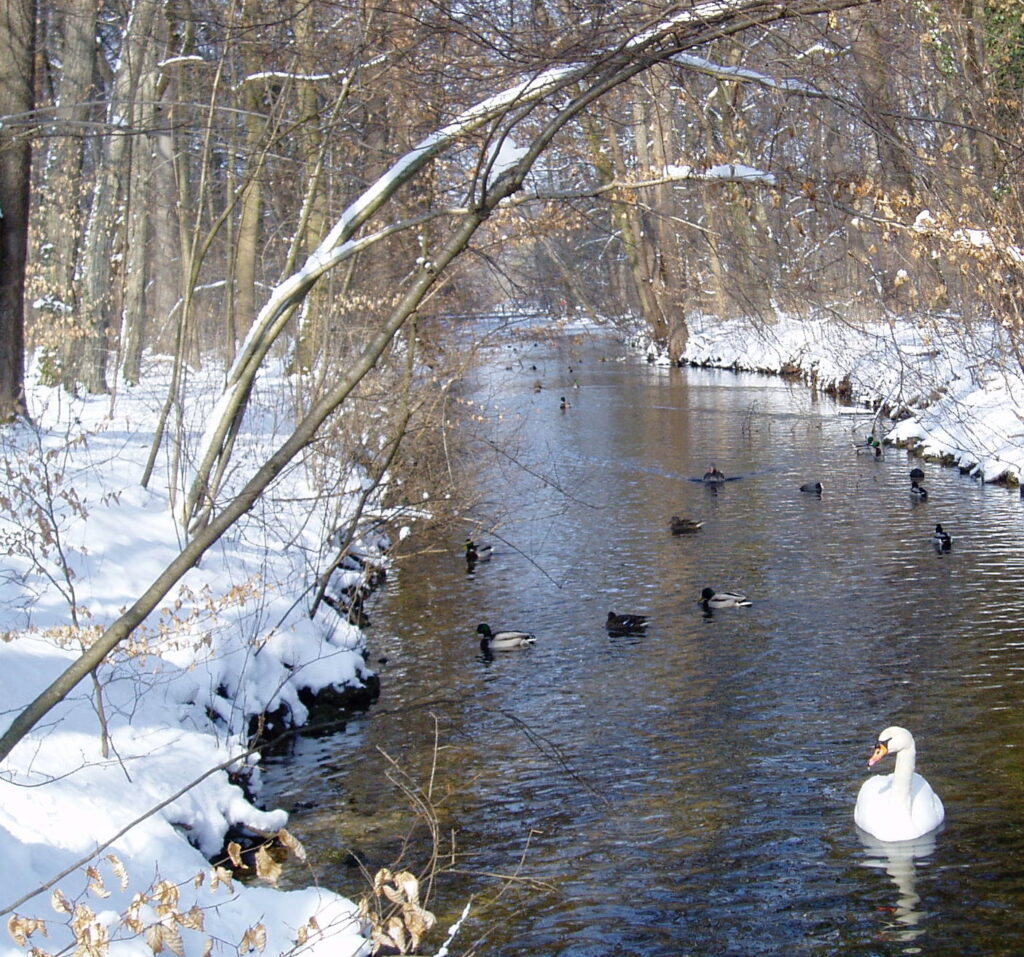
Mary had a little lamb
Its fleece was white as snow.
When Thomas Edison recited these lines in 1877 he made the first ever sound recording of a metaphor or simile.
https://en.wikipedia.org/wiki/File:Thomas_Edison_Mary_had_lamb.ogg
Although the image is seemingly straightforward (the wool and the snow are both the same colour), it carries with it endless cultural associations which connect whiteness with purity and innocence. King David made the link explicit when repenting his sin with Bathsheba in Psalm 51:
Purge me with hyssop, and I shall be clean; wash me, and I shall be whiter than snow.

Psalm 51:7 (KJV)
In many of the Schubert song texts snow therefore simply appears as shorthand for purity and simplicity, as in the rather strange text in praise of a wife and mother that Schubert set for male quartet (D 984):
In schöner, heller Winterzeit
Ward eine Maid geboren,
Der Winter, den ihr Anblick freut,
Hat sie zum Lieb erkoren.

Sprach: Leben wie der Schnee so weiß,
Wie Eis so klares Denken,
Doch gleich der Wunderquelle heiß,
Will ich ein Herz ihr schenken,

Es wird, wenn sie den Gatten wählt,
Die Wahl sie nie betrüben,
Sie ist ihm theurer als die Welt,
Er wird sie ewig lieben.

In beautiful, bright winter time
A girl was born,
Winter, who rejoiced in her appearance,
Chose her as his lover.

He said: A life as white as snow -
A mind as clear as ice,
Yet just as hot as a healing spring
Will be the heart that I bestow on her.

When she chooses her husband she will
Never regret that choice,
She is dearer to him than the whole world,
He will love her for ever.

Anonymous, Der Wintertag	D 984
At the climax of Minona oder die Kunde der Dogge (D 152) the heroine encounters the body of her lover (Edgar) killed by her own father, and immediately decides to take the arrow that has slaim him and plunge it into her own breast, which is said to be ‘as dazzling as snow’ (so blendend als Schnee). In stories like this the physical whiteness pales into insignificance because of the power of the notion of purity and devotion.
The metaphor operates slightly differently in Rellstab’s Frühlingssehnsucht (D 957/3). Here there is no literal snow at all. The poet sees the white petals of blossom as snowflakes and associates walking through the woods in springtime with walking through a snowy landscape (or perhaps even a snow shower if it is ‘snowing’ blossom). Yet immediately the juxtaposition links snow with the whiteness of purity in the image of ‘bridal light’.
Grünend umkränzet
Wälder und Höh,
Schimmernd erglänzet
Blütenschnee.
So dränget sich alles zum bräutlichen Licht,
Es schwellen die Keime, die Knospe bricht,
Sie haben gefunden was ihnen gebricht,
Und du?

With a green garland all around
Stand the forests and the hills!
Shining and glowing there -
Snow-like blossom!
Thus everything is pushing up towards the bridal light;
The seeds are bursting, the buds are breaking open;
They have found what they needed:
And you?

Rellstab, Frühlingssehnsucht D 957/3
When the snow is real and a genuine example of extreme weather (as in Winterreise) it becomes a metonym for all the adversity that human beings have to deal with in the course of life.
Dem Schnee, dem Regen,
Dem Wind entgegen,
Im Dampf der Klüfte,
Durch Nebeldüfte,
Immer zu, immer zu,
Ohne Rast und Ruh!

Lieber durch Leiden
Möcht´ ich mich schlagen,
Als so viel Freuden
Des Lebens ertragen!
Alle das Neigen
Von Herzen zu Herzen,
Ach wie so eigen
Schaffet das Schmerzen!

Wie soll ich fliehn?
Wälderwärts ziehn?
Alles vergebens!
Krone des Lebens,
Glück ohne Ruh,
Liebe, bist du!

Snow, rain,
Wind: facing up to them all.
In the steam of gorges,
Through the scent of mist.
Keep on! Keep on!
Without stopping and without rest!

I would rather use suffering
To beat myself,
Than bear so many of the joys
Of life like this!
All of this subjugation
Of heart to heart,
Oh, how strangely
Agony is created!

How should I escape?
Should I go towards the woods?
It is all pointless!
Crown of life,
Bliss without peace -
Love, that is what you are!

Goethe, Rastlose Liebe	D 138


Fliegt der Schnee mir ins Gesicht,
Schüttl' ich ihn herunter.
Wenn mein Herz im Busen spricht,
Sing ich hell und munter.

* * *

Lustig in die Welt hinein
Gegen Wind und Wetter;
Will kein Gott auf Erden sein,
Sind wir selber Götter!

If the snow flies into my face
I shake it off.
If my heart speaks inside my breast
I sing clearly and cheerfully.

* * *

Happily going out into the world
Against the wind and weather!
If there is not going to be any God on earth
We ourselves are gods.

Müller, Mut! D 911/22
This struggle against the elements often involves climbing high into the snow-topped mountains:
Die Winde sausen
Am Tannenhang,
Die Quellen brausen
Das Tal entlang;
Ich wandre in Eile
Durch Wald und Schnee,
Wohl manche Meile
Von Höh zu Höh.
The winds are roaring
On the slopes covered in fir trees,
The springs are gurgling
All along the valley,
I have been rushing along
Through woods and snow
For many a mile now,
From hilltop to hilltop.
Schulze, Über Wildemann D 884
Was vermeid ich denn die Wege,
Wo die andern Wandrer gehn,
Suche mir versteckte Stege
Durch verschneite Felsenhöhn?
So why am I avoiding the paths
Where the other travellers go,
Why do I search out hidden pathways for myself
Across the snow-covered rocky heights?
Müller, Der Wegweiser D 911/20
Just as snow can physically cover a mountain top it can act metaphorically as our final covering as we lie in the grave. Such shrouds or blankets of snow and ice offer cold comfort, though.
In bräutlich heller Feier
Erscheint der Blumen Pracht,
Doch fern schon ist der Freier,
Wild glüht der Sonne Macht.

Nun künden ihre Düfte,
Dass sie voll Sehnsucht sind,
Was labend würzt die Lüfte,
Es ist der Schmerzen Kind.

Die Kelche sinken nieder,
Sie schauen erdenwärts:
"O Mutter, nimm uns wieder,
Das Leben gibt nur Schmerz."

Die welken Blätter fallen,
Mild deckt der Schnee sie zu -
Ach Gott! so geht's mit allem,
Im Grabe nur ist Ruh!

In bright, bridal celebration
The display of flowers appears,
Yet the suitor is far away,
The power of the sun is burning savagely.

Now their scents announce
That they are full of longing.
What adds such spice to the breezes
Derives from their sorrow.

The sepals sink down,
They look towards the earth:
"Oh mother, take us back,
Life has only sorrow to offer."

The faded petals and leaves fall,
The snow gently covers them -
Oh God, that is how it goes with everything,
Only the grave offers rest.

Mailáth, Der Blumen Schmerz	D 731

Im Wald, im Wald da grabt mich ein,
Ganz stille,ohne Kreuz und Stein,
Denn was ihr türmet, überschneit
Und überrindet Winterszeit.

Und wann die Erde sich verjüngt
Und Blumen meinem Hügel bringt,
Das freut euch Guten, freuet euch,
Dies alles ist dem Toten gleich.

Doch nein, denn eure Liebe spannt
Die Äste in das Geisterland,
Und die euch führt zu meinem Grab,
Zieht mich gewaltiger herab.

In the forest, in the forest, that is where you should bury me,
In total silence, without any cross or stone:
Since the heap that you are making will be covered with snow
And ice by the winter weather.

And when Earth rejuvenates itself
And brings flowers to my mound,
Then rejoice, good people, rejoice!
It is all the same to the dead.

But no - since your love spreads
Its branches into the land of the spirits,
And what leads you towards my grave
Pulls me more powerfully downwards.

Mayrhofer, An die Freunde	D 654
☙
Descendant of:
Inanimate nature WaterTexts with this theme:
- Adelaide, D 95 (Friedrich von Matthisson)
- Erinnerungen, D 98, D 424 (Friedrich von Matthisson)
- Mailied (Der Schnee zerinnt), D 130, D 202 (Ludwig Christoph Heinrich Hölty)
- Rastlose Liebe, D 138 (Johann Wolfgang von Goethe)
- Minona oder die Kunde der Dogge, D 152 (Friedrich Anton Franz Bertrand)
- Der Liedler, D 209 (Joseph Kenner)
- Der Abend (Der Abend blüht), D 221 (Ludwig Theobul Kosegarten)
- Trinklied im Winter, D 242, D deest (Ludwig Christoph Heinrich Hölty)
- Pflügerlied, D 392 (Johann Gaudenz von Salis-Seewis)
- Freude der Kinderjahre, D 455 (Friedrich von Köpken)
- Lied (Ferne von der großen Stadt), D 483 (Caroline Pichler)
- An die Freunde, D 654 (Johann Baptist Mayrhofer)
- Der Blumen Schmerz, D 731 (Johann (János) Nepomuk Josef Graf Mailáth)
- Die böse Farbe, D 795/17 (Wilhelm Müller)
- Über Wildemann, D 884 (Ernst Konrad Friedrich Schulze)
- Jägers Liebeslied, D 909 (Franz Adolph Friedrich von Schober)
- Gute Nacht, D 911/1 (Wilhelm Müller)
- Erstarrung, D 911/4 (Wilhelm Müller)
- Wasserflut, D 911/6 (Wilhelm Müller)
- Rückblick, D 911/8 (Wilhelm Müller)
- Der Wegweiser, D 911/20 (Wilhelm Müller)
- Mut! D 911/22 (Wilhelm Müller)
- Der Winterabend, D 938 (Carl Gottfried von Leitner)
- Frühlingssehnsucht, D 957/3 (Ludwig Rellstab)
- Der Wintertag, D 984 (Anonymous / Unknown writer)