

Tod, du Schrecken der Natur,
Immer rieselt deine Uhr,
Die geschwungne Sense blinkt,
Gras und Halm und Blume sinkt.

* * *

Tod, wann kommst du? meine Lust!
Ziehst den Dolch aus meiner Brust,
Streifst die Fessel von der Hand,
Ach, wann deckst du mich mit Sand.


Death, what a horror of nature you are!
Your hour-glass is always trickling,
The scythe you swing flashes,
Grass, stalk and flower sink.

* * *

Death, when are you going to come? My delight!
Pull the dagger out of my breast;
Slip the shackles off my hand.
Oh, when are you going to cover me with sand?

Schubart, An den Tod		D 518
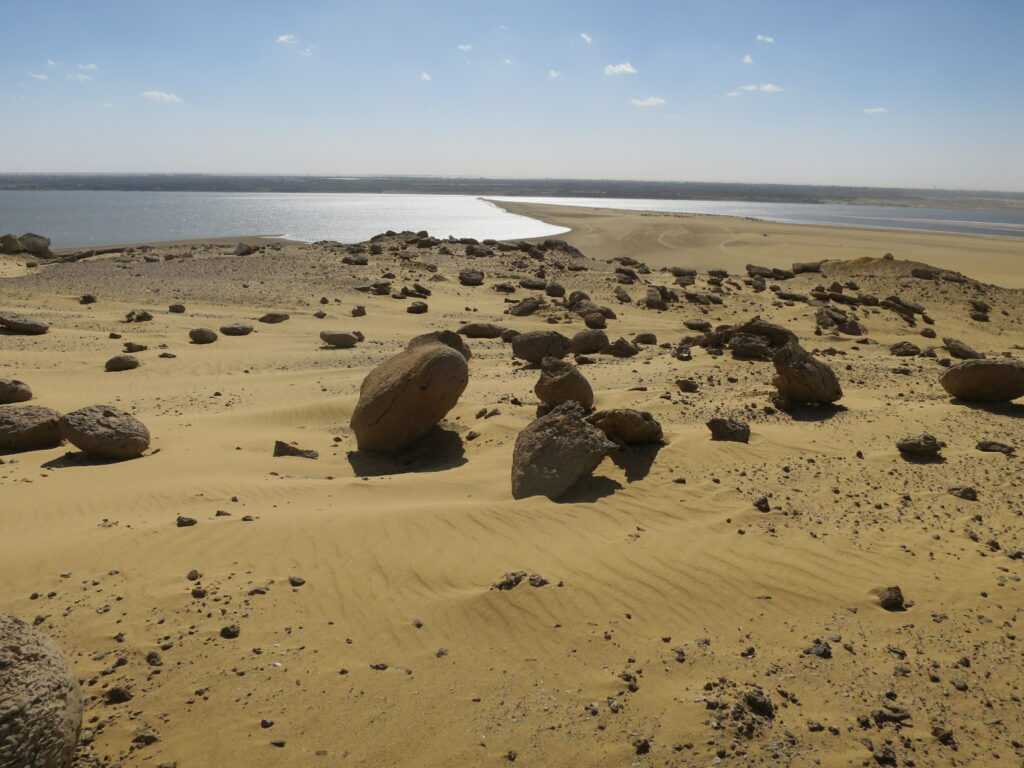
These verses from Schubart’s ‘To Death’ introduce the two major roles of ‘sand’ as an image in the Schubert song texts: the sands of time and burial. Father Time is carrying the hour glass in which the grains of sand measure out our allotted minutes. In the other stanza a figure in despair (probably a prisoner, like the poet who wrote this text) longs to die and be covered in sand. There may here be a hint of Archimedes, who wrote a Treatise (‘The Sand Reckoner’, Ψαμμίτης) on measuring the universe by counting the grains of sands it might contain and his follower Archytas, who features prominently in one of Horace’s Odes. In this Ode a drowned sailor begs a fellow seaman to cast three grains of sand on his unburied body to release him into death.
We learn only half-way through that the speaker here is not, as usual, Horace, but a drowned sailor who, because he is unburied, is earthbound, and cannot cross the river Styx to the underworld. He addresses, first, Archytas, buried nearby, a famous scientist and follower of the sage and mathematician Pythagoras; then a passing mariner whom, alternating pleas with threats, he calls on to perform his burial rites – three handfuls of sand would be enough. https://www.pantheonpoets.com/poems/a-plea-for-burial/
You, my Archytas, philosopher, and measurer of land,
of the sea, of wide sands, are entombed
in a small mound of meagre earth near the Matinian shore,
and it’s of no use to you in the least,
that you, born to die, have explored the celestial houses
crossed, in spirit, the rounds of the sky.
Tantalus, Pelop’s father, died too, a guest of the gods,
and Tithonus took off to the heavens,
Minos gained entry to great Jupiter’s secrets, Tartarus
holds Euphorbus, twice sent to Orcus,
though he bore witness, carrying his shield there, to Trojan times,
and left nothing more behind, for black Death,
but his skin and his bones, and that certainly made him, Archytas,
to your mind, no trivial example
of Nature and truth. But there’s still one night that awaits us all,
and each, in turn, makes the journey of death.
The Furies deliver some as a spectacle for cruel Mars,
the greedy sea’s the sailor’s ruin:
the funerals of the old, and the young, close ranks together,
and no one’s spared by cruel Proserpine.
Me too, the south wind, Notus, swift friend of setting Orion,
drowned deep in Illyrian waters.
O, sailor, don’t hesitate, from spite, to grant a little treacherous
sand, to my unburied bones and skull.
So that, however the east wind might threaten the Italian
waves, thrashing the Venusian woods,
you’ll be safe, yourself, and rich rewards will flow from the source,
from even-handed Jupiter, and from
Neptune, who is the protector of holy Tarentum. Are you
indifferent to committing a wrong
that will harm your innocent children hereafter? Perhaps
a need for justice, and arrogant
disdain, await you, too: don’t let me be abandoned here
my prayers unanswered: no offering
will absolve you. Though you hurry away, it’s a brief delay:
three scattered handfuls of earth will free you.
Horace, BkI:XXVIII, Three Handfuls of Earth English translation by A.S. Kline
☙
Descendant of:
Inanimate nature WaterTexts with this theme:
- Furcht der Geliebten – An Cidli, D 285 (Friedrich Gottlob Klopstock)
- Fischerlied, D 351, D 364, D 562 (Johann Gaudenz von Salis-Seewis)
- An den Tod, D 518 (Christian Friedrich Daniel Schubart)
- Philoktet, D 540 (Johann Baptist Mayrhofer)
- Sonett (Allein, nachdenklich), D 629 (Francesco Petrarca and August Wilhelm Schlegel)
- O Quell, was strömst du rasch und wild, D 874 (Ernst Konrad Friedrich Schulze)